Showing posts with label Math. Show all posts

Tuesday, November 6, 2018

Math Workspaces

We have been working hard to learn routines and independent work habits, so far in kindergarten.  I'm happy to report that kids LOVE our independent Work Spaces in math and they are really learning how to focus on their task and stick with it.

This week we introduced our Number Racks, also called Rekenreks.  The game they play involves pulling a Ten Frame Card and then moving the correct number of beads to the opposite side of the rack.  At this time, we are only using the top rack.

We have been working on subitizing, or seeing a set and knowing the number right away.  The ten frame  helps us to see the number.  Kids are starting to recognize a full ten frame as 10, a half full ten frame as 5, etc.


We have been working on creating and extending patterns.


One of our favorite Work Spaces involves the pattern blocks, putting shapes together, and creating shape pictures.  


Continuing with our number work, we have some number and ten frame matching games to play.


I've been so impressed with the independent work skills the kids are learning.  As a school, we work to take care of ourselves, take care of our school, and take care of each other.  By working independently, helping their friends when they need it, cleaning up after themselves, caring for our materials, and consistently working hard, they are certainly following our school guidelines!

I'm so proud of their work!

Friday, September 16, 2016

Math Exploration

With week number 1 under our belts, the kids and I are feeling good about our accomplishments so far!  We spent the week exploring some of our different math materials and figuring out how some of the pieces fit together.  It's important for us to start slowly and make sure we understand the expectations with our materials.
There was a lot of creating and there was also counting.


Kids figured out how to build with materials they may not have used before.


There was sorting, counting, and even a bit of dramatic play.


We made lots of different creations and learned that Mrs. Ross prefers that we not build weapons with link cubes.


Our Bridges math lessons will begin on Monday, but we will continue to provide these math materials in our Math Work Places. After our whole class lesson, kids will go to self-selected Work Places to build and create.  As the year progresses, we will have specific tasks that kids will be doing at the Work Places.  


Happy learning!

Saturday, October 31, 2015

Math Work Spaces

This year we have a new math curriculum in the Snohomish School District.  We are using the Bridges curriculum.  I have to say, I am really liking it so far.  It's developmentally appropriate for kindergarten and has a lot of fun games that provide practice time for the kids.

Every day we start our math time with a whole class mini-lesson.  After the mini-lesson, we head off into Work Spaces.  Each table in our classroom becomes a Work Space and the kids have jobs to do.  

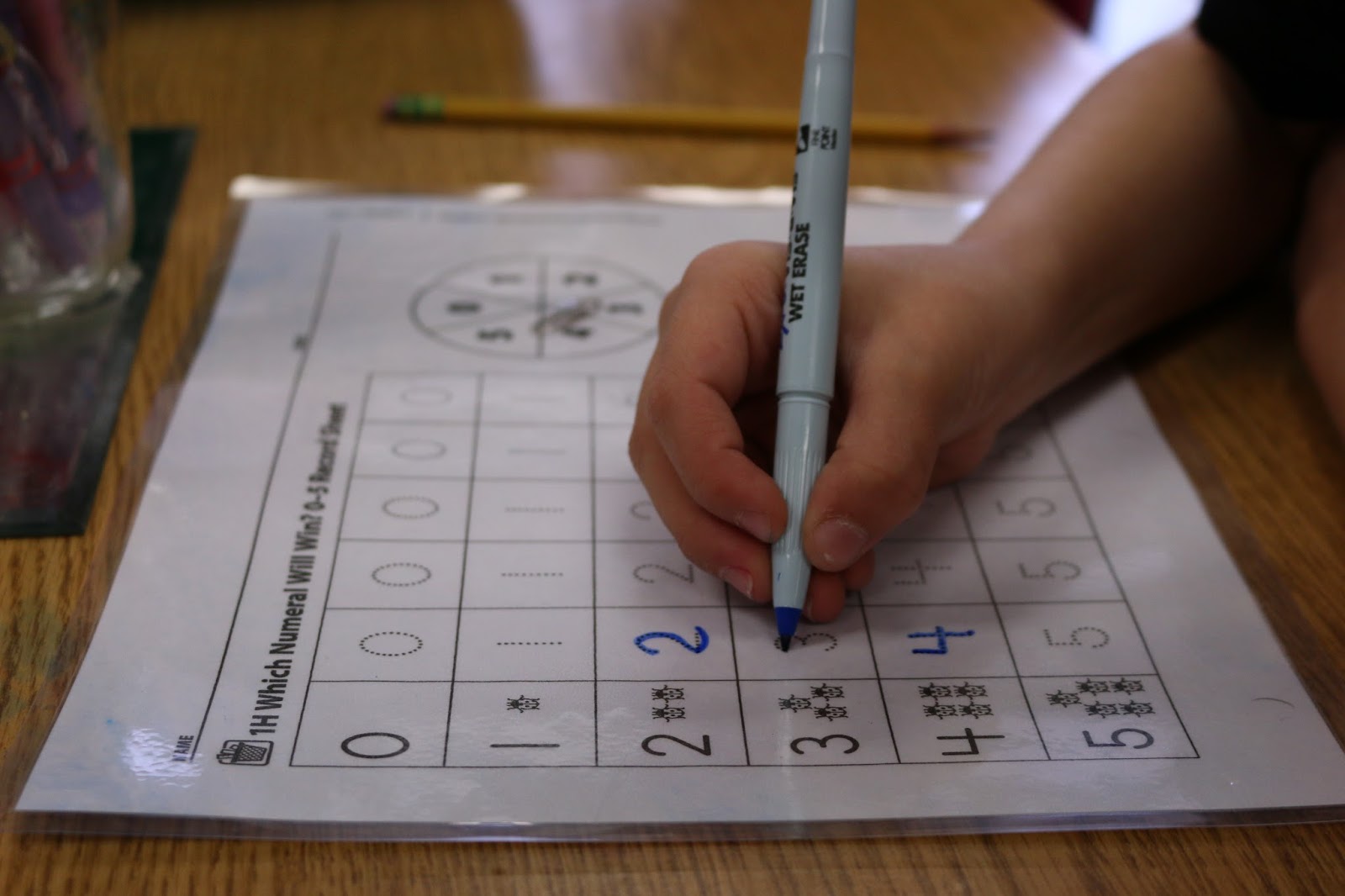
Here is a game where the kids spin the spinner and practice writing the number they spin.  We are working on proper number formation and always starting to write our numbers at the top.


We use write and wipe markers on laminated sheets.


Here's another station where kids work with partners to play a game where they are adding numbers to total 5.


One of our newest Work Spaces is our pattern activity.  Kids build patterns and then document their pattern by coloring it onto their recording sheet.


One of the favorite Work Spaces is Spill the Beans.  Kids start with five beans and spill them onto the table.  Then they record how many red beans they have, again focusing on correct number formation as they are writing.


So far, Math Work Spaces have been a hit in kindergarten!  The kids are enjoying them and learning so much every day!

Happy learning!

Thursday, April 23, 2015

Number Bonds

We've been working on Number Bonds this year and I wanted to show families an example of what this looks like.  Kids will use Number Bonds all the way through school as a way of seeing that numbers go together.  This is an example we've been using with number bonds, when working with our teen numbers.  We put the sum of our number bond in the top square or the biggest square, and then show the parts of that number.


Obviously, there are many more ways to make 15.  If kids put 8 and 7 in the bottom boxes, they would be correct, but our purpose today was to use the teen numbers.  We want to show that 10 and another number makes our teen number.  


I love using number bonds as a visual for kids who are beginning to understand the relationship between numbers. I also love the idea of telling a story about these numbers.  Here's an example:

"This is a math mountain. It's called the 15 Math Mountain.  There were 15 tiny rocks sitting at the top of 15 Math Mountain.  We'll call these rocks tiny tumblers.  One day the mountain started to rumble and the rocks started to fall.  10 tiny tumblers rolled down one side of the math mountain.  All of the rest rolled down the other side. How many rolled down the other side?"

Sometimes I will have kids draw the tiny tumblers on the side of the mountain as a visual.  (Drawing tiny tumblers is also great to develop fine motor skills!)

Here's a tip to file away, especially as kids get older.  Amazon sells triangular flash cards that use this same idea of number bonds.  This is what they look like.  This is an example of the addition and subtraction flash card.  You would simply cover one corner (any corner you want) and ask your child what the number is that is missing.  For most kindergarten students, this is more than they are ready for right now.  It's a great product and something you might be interested in purchasing as they get older.  They also sell these in multiplication and division.  Here's the link to the product on Amazon.  


You will notice number bonds on the homework this week.  Hope this little blog post helps with that!

Monday, April 20, 2015

Counting By Tens

We've been working on counting by 10's to 100 all year long, but this week we put that practice into action. We've been using our 10 Frames to help us figure out how many color tiles we have.


During our Independent Practice time, kids counted 10 frames and wrote the number of dots that were represented.  Writing our "decade" numbers is not always an easy task!  Often times, kids confuse 14 with 40 and 13 with 30.  We will be practicing how to read, write and count these numbers in the coming weeks!


Happy counting!

Friday, February 13, 2015

Valentine Fun!

It was a card-passing, cookie-decorating, candy-heart-graphing good time in kindergarten yesterday!  I would say it was a successful day!  My daughter bounced off to school in the morning, telling me it was the BEST day of the year.  I always forget how much I loved these days as a kid.  We embraced the craziness of Valentine fun, and incorporated some learning into the day too. (I have never seen them as engaged as they were when they were graphing their candy hearts)


Happy Valentine's Day!

Wednesday, December 3, 2014

Math Stations

In addition to our new Engage New York math curriculum, I've also been adding several hands-on math stations. The stations are based on current concepts we are working on.

Here is our Gingerbread 10 frame game.

We have a counting path game that also connects with numeral recognition. You may remember homework that asked kids to create a counting path with their finger as they count.


I've loaded some fun new kindergarten math games on the LeapPads.


The bingo markers are a big hit. Kids are using a ten frame and numeral cards to show how many.


We've been working hard to learn the proper way to write are numbers. Our dry erase books give us a little practice.


Clay number mats are a fun way to practice too.


Pete The Cat's Groovy Buttons is a hit with the kindergarten crowd! Kids draw a number and then show how many on the ten frame. You've just gotta' love Pete!


Math stations are a nice break from the Engage New York lessons and seem to compliment our work well!

Learning About +1

We've been working on the concept of +1 in math. One of the hands-on approaches to developing this concept is through staircases.

We talk about starting with 1, and then what happens when we add 1 to that. We repeat the process until we get to 10.  The + symbol has been new learning for many of the kids and so has the idea of building a staircase. While some kids can just see the idea behind the staircase and build it, others need to be taught how to do this. 

This is a great concept to work on at home. Have your child build a staircase out of Cheerios. Start with 1 and then work through "+1" until they get to 10. For advanced kids, have them try writing the +1 number partners as they go. 4+1, 5+1, 6+1.

Happy counting and adding!

Friday, October 17, 2014

Wild Things

 Today, in Kindergarten, we read the classic book, Where the Wild Things Are, by Maurice Sendak.

We spent a lot of time trying to infer what was happening in the story and what we thought the author was trying to tell us.  We also looked carefully at the different features each wild thing had.  Some had scales, some feathers, some wore stripes, and some had fur.  The kids picked their favorite wild thing and then we were ready for our project.


The kids made their own wild things with oil pastels.  This is only the second time we've used oil pastels in art, and the kids did a great job.  Getting just the right amount of pressure is always a challenge with oil pastels.  As kids were drawing, they naturally started counting and we heard things like, "My wild thing has two horns."  I pointed out that this was math conversation and to keep those numbers in mind as they were working because we'd be labeling our work shortly. (I love it when kids' conversations naturally lead where I'm about to take them!)


The labeling began shortly after kids finished their wild things. We counted claws, legs, teeth, stripes, feet, and many more features. Kids wrote the number next to the area they wanted to label and we encouraged them to use the beginning sound of the words to show which part they were labeling.  "5 C," for example, means 5 claws on that hand.


This is always one of my favorite lessons in the fall.  It incorporates using new materials (oil pastels), a classic children's book, art, math, and writing.  The morning class finished their wild things today and they are bringing them home. The afternoon class will be doing theirs on the next Friday they attend.  If your child is bringing home their wild thing today, please ask them about it!  Have them read you their labels and practice counting together.  It's a great book to keep in mind if you are wanting to take a trip to the public library too!
  

Wednesday, October 1, 2014

Bats In A Cave - Day 2

Yesterday I shared with you the game we played during math time.  Our main focus was on Conservation Of Number.  We worked on the idea that even when we move around our five bats (beans), there are still going to b 5.  Today's focus was on parts of number.


There are full directions for playing the Bats In A Cave Addition game on the LeapFrog Learning Path Website if you are interested.  We played the game with 3 bats and took turns hiding bats and guessing how many were hiding.  The kids loved the game and I sent home 5 beans with each student today.  I told them it was their job to teach parents how to play the game, but the directions are on the LeapFrog website (above) for parents as well.  I would start your child playing the game with only 3 bats, and then move to 4 or 5 as they are ready and becoming more confident.

Tuesday, September 30, 2014

Bats in a Cave

We played a math game today called Bats In A Cave.

Our Engage NY curriculum suggested playing a similar game with bears and individual tubs, but we changed it up a bit.  Our focus was on "Conservation of Number" where kids develop an understanding that if they started with 5 and put 2 on top, there would still be 5 all together... we just moved them around a bit. It's the same idea as having 20 objects all in a line and then messing them all up.  There are still 20 objects there, but the five year old brain doesn't realize that.

There are full directions for playing the Bats In A Cave Addition game on the LeapFrog Learning Path Website if you are interested.  The game we played in class was specifically focused on Conservation of number, while the game on the LeapFrog website has more of an addition/subtraction focus.  It a really simple and fun way to work on number fluency with your kids at home!

Happy counting!